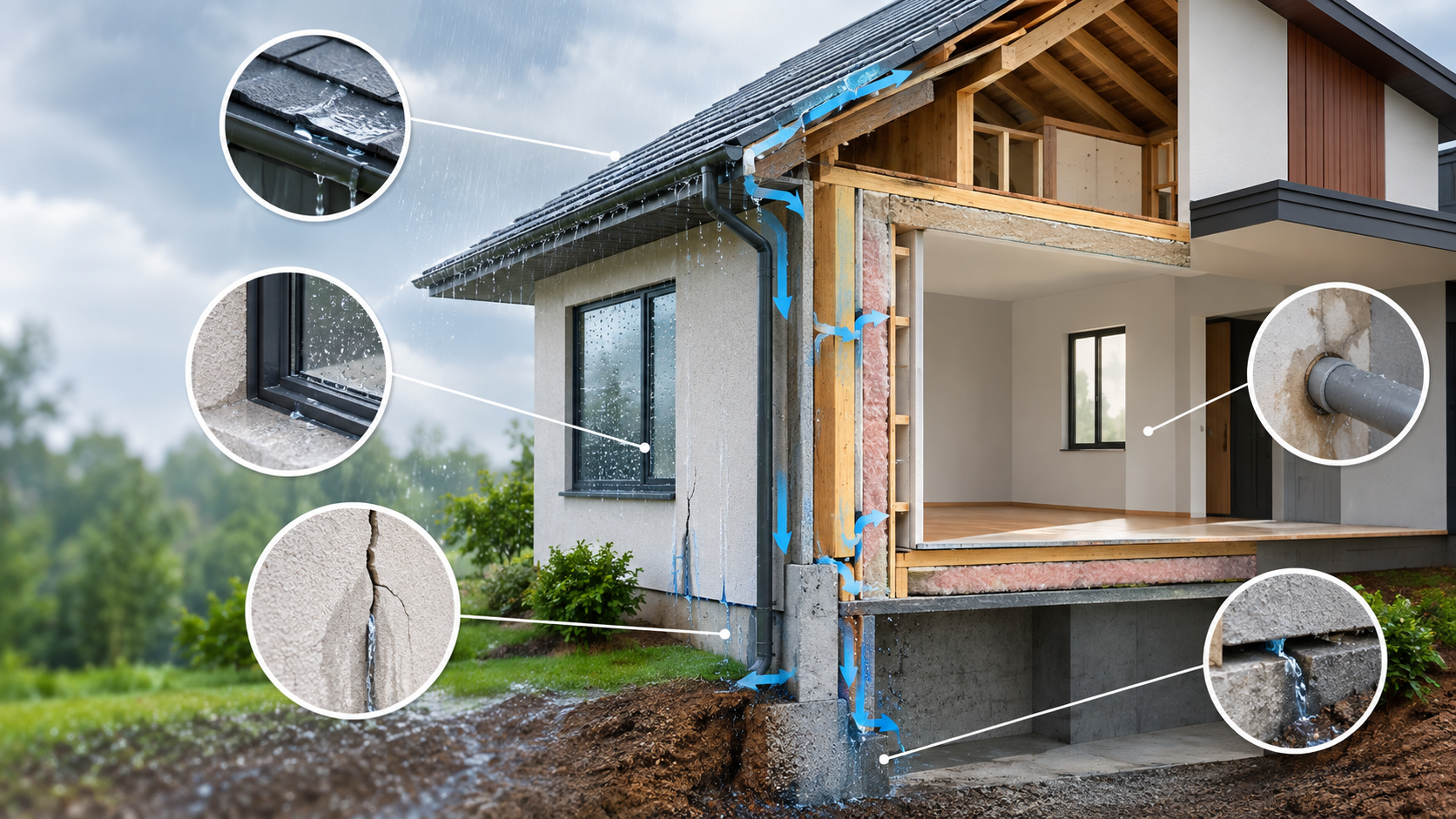
Water is one of the most persistent sources of building deterioration. It can enter through a visible opening, travel through building materials and eventually appear somewhere that seems completely unrelated to the original entry point.
This is why identifying moisture problems is not always as simple as finding a damp patch or water stain.
A moisture-related issue may begin around a roof penetration, window, balcony, bathroom, external wall, gutter or drainage area. The visible symptoms can then appear some distance away from where water first entered.
Understanding moisture entry paths is therefore an important part of assessing a property’s condition, particularly when purchasing an established or recently constructed home.
Why Understanding Water Movement Matters
Buildings are designed to control and direct water. Roofs, gutters, flashings, drainage systems, waterproofing, seals and external finishes all contribute to keeping unwanted moisture away from internal areas.
When one of these elements is damaged, poorly maintained or incorrectly installed, water may find an alternative path.
The challenge is that water does not always travel in a straight line.
Gravity can draw water downward, while building materials, joints, cavities and surface conditions can influence the direction it takes. Moisture may also remain within materials before becoming visible.
As a result, the location where a problem becomes noticeable may not be the location where the problem originated.
For a building inspector, this makes the relationship between different observations particularly important.
Common Moisture Entry Points
There are several areas of a property where water can potentially enter or accumulate.
1. Roofs and Roof Penetrations
The roof is one of the property’s primary barriers against rainwater.
Roof coverings, flashing, penetrations, valleys, junctions and drainage components all need to work together to direct water away from the building.
Potential concerns can include deteriorated roof materials, damaged flashing, blocked drainage paths, defective seals or poorly detailed penetrations.
A problem in one area may allow water to enter the roof space or adjoining building materials. Internal staining or deterioration may only become noticeable later.
This is one reason visible ceiling damage should not automatically be assumed to originate directly above the affected area.
2. Gutters and Downpipes
Gutters and downpipes play an important role in controlling roof water.
Blocked gutters, damaged sections, inadequate discharge arrangements or overflowing water can result in water being directed towards areas where it should not accumulate.
Repeated overflow can contribute to deterioration around eaves, external walls and adjoining surfaces.
During an inspection, visible drainage conditions can therefore provide useful information about how rainwater is being managed around the property.
3. Windows and External Doors
Windows and external doors contain multiple junctions where different materials meet.
Frames, seals, flashings, sills and surrounding finishes all have a role in limiting unwanted water entry.
Deteriorated sealant, damaged components, poor drainage or gaps around openings can create potential moisture entry points.
Water may then move into surrounding materials before becoming visible internally.
Signs such as staining, damaged finishes, deterioration around openings or moisture-related changes should be considered in context rather than viewed in isolation.
4. External Walls and Junctions
External walls are continuously exposed to weather.
Their performance depends on the condition and interaction of various components, including external finishes, joints, openings, flashings and drainage provisions.
Junctions between different materials can be particularly important because changes in material, movement and weather exposure can create areas where water management becomes more challenging.
Visible deterioration around these locations can warrant closer inspection.
5. Bathrooms and Wet Areas
Internal moisture does not only come from outside the building.
Bathrooms, laundries and other wet areas are regularly exposed to water. Their performance depends on appropriate waterproofing, drainage, floor falls, seals and connections around fixtures and penetrations.
Water escaping from a wet area may affect adjoining finishes or rooms.
Importantly, visible damage may not identify the precise source of the moisture. A damp or deteriorated area should therefore be assessed alongside surrounding conditions.
6. Balconies and Outdoor Areas
Balconies and similar exposed areas are subject to rainfall and regular weather exposure.
Their ability to manage water depends on factors such as drainage, surface falls, junctions, finishes and waterproofing systems.
Where water does not drain effectively, it may remain against surfaces or find pathways into adjoining areas.
Visible deterioration, staining or moisture-related symptoms around adjoining internal areas may justify further attention during an inspection.
7. Ground Levels and Surface Drainage
Water can also enter a property from ground level.
The way paving, soil, garden beds and other external surfaces interact with the building can influence how rainwater moves around the property.
Poor surface falls or inadequate drainage can allow water to remain close to external walls rather than being directed away.
This is particularly relevant after periods of heavy rainfall, when drainage deficiencies may become more apparent.
Water Does Not Always Appear Where It Enters
One of the most important concepts when assessing moisture problems is that the visible symptom may not be the source.
For example, water entering around an external opening may travel through adjoining materials before appearing as staining on an internal wall.
Similarly, a ceiling stain may not necessarily indicate that the roof covering directly above that point is the only possible source.
This makes moisture investigation a process of connecting observations.
An inspector may consider:
- The location of visible staining
- The condition of nearby surfaces
- Roof and drainage conditions
- External openings
- Signs of deterioration
- Moisture readings where appropriate
- Weather exposure
- The age and condition of the property
- Previous repairs or alterations
No single observation should automatically be treated as confirmation of the source.
Common Signs of Moisture Problems
Moisture-related issues can present in different ways.
Some visible signs include:
- Water staining
- Discolouration
- Peeling or damaged finishes
- Swelling or deterioration of materials
- Mould or fungal growth
- Corrosion
- Damp or musty areas
- Deteriorated sealants
- Efflorescence or salt deposits
- Damage around windows, ceilings or wet areas
However, the presence of one of these signs does not necessarily identify the cause.
For example, discolouration could have several possible explanations depending on its location, surrounding conditions and history.
This is why an inspection should consider the broader context rather than focusing only on the most obvious symptom.
Why Moisture Problems Can Become More Difficult Over Time
Repeated moisture exposure can contribute to progressive deterioration.
A small defect may initially have little visible impact. If water continues to enter or remain in an affected area, however, materials may deteriorate further.
Over time, this can result in:
- Initial water entry
- Moisture reaching surrounding materials
- Repeated exposure
- Deterioration of finishes or components
- Visible staining or other symptoms
- Potentially more extensive repair requirements
The timeline will vary depending on the source, materials, environmental conditions and extent of exposure.
This is why identifying potential moisture entry paths early can be valuable for property owners and prospective buyers.
The Importance of Looking at Defects in Context
A building inspection is not simply a search for individual defects.
The relationship between observations can provide important information.
For example, an inspector may observe:
- Poor drainage near an external wall
- Deteriorated finishes in the same general area
- Signs of moisture internally
Individually, each observation may appear relatively minor. Considered together, they may indicate that further investigation is warranted.
This broader approach helps distinguish isolated maintenance matters from patterns that may require additional attention.
What a Building Inspection Can Identify
A building inspection generally involves a visual assessment of accessible areas and components.
Depending on the scope of the inspection and site conditions, an inspector may identify visible signs that could indicate moisture-related concerns, such as deterioration, staining, drainage issues, damaged finishes or other observable conditions.
Moisture meters or other non-destructive tools may also be used where appropriate.
However, testing results need to be interpreted alongside visual observations and site conditions. A reading by itself does not necessarily establish the source, cause or extent of a moisture problem.
Where the cause or extent of an issue cannot be established through a standard visual inspection, further investigation by an appropriately qualified specialist may be recommended.
Why Finding the Source Matters
Treating only the visible symptom may not resolve an ongoing moisture problem.
For example, repainting a stained surface may improve its appearance, but if water continues to enter from another location, the underlying issue may remain.
The objective should therefore be to understand:
Where could the moisture be coming from?
How could it be reaching the affected area?
What visible evidence supports that possibility?
Does the issue require further investigation?
These questions provide a more useful approach than simply identifying the presence of a stain or damp area.
What Property Buyers Should Take Away
When inspecting a property, moisture-related observations should not automatically be viewed as evidence of a major defect.
At the same time, they should not be dismissed simply because the visible damage appears minor.
The significance of a moisture-related finding depends on factors such as its location, extent, recurrence, surrounding conditions, property age, maintenance history and whether an active source can be identified.
For buyers, understanding these factors can help provide a clearer picture of the property’s condition before making a purchasing decision.
Final Thoughts
Water can follow complex paths through and around a building. The point where moisture becomes visible may be different from the point where it first entered.
That is why effective inspection involves more than identifying stains, dampness or damaged finishes. It involves considering how different building components interact and whether multiple observations could be connected.
Understanding moisture entry paths can help property owners and buyers recognise potential warning signs and understand when further investigation may be appropriate.
A professional building inspection can provide an important visual assessment of accessible areas and identify conditions that may warrant attention before a property purchase or as part of ongoing property maintenance.